
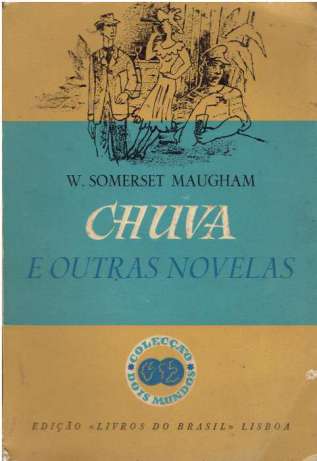
CHUVA (1921)
Autor: Somerset Maugham
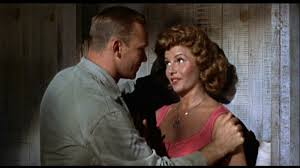
Realizador: Curtis Bernhardt (1953)
Apesar da presença magnética de Rita Hayworth, a maliciosa novela de Maugham não recebe o tratamento merecido nesta espécie de musical adulterado pela censura, que transformou uma prostituta em dançarina de cabaré.
Li o livro mas nunca vi o filme.
🙂 Antonieta
O livro é bem melhor, Antonieta.
A.M.
Eis um escritor sólido e que prende.
“Exame de consciência”: é um livro a rever.
“The Summing Up” (1938) is an introspective attempt at bringing together Maugham’s thoughts on subjects that had primarily interested him through the course of his life- ideas on literature, art, religion, ethics, and philosophy- in a conclusive, coherent manner.
Maugham began by stating that this book was neither intended as an autobiography nor a book of recollections. In fact, he clearly noted that certain aspects of his life would remain unmentioned, private; and provided no license for any biographies in his lifetime. He felt that to give them weight would detract from the important life points upon which he wished to focus.
He was always bothered by setting down his thoughts in the first person, considering that he was more comfortable speaking through the characters in his novels.
“Fact and fiction are so intermingled in my work that now, looking back on it, I can hardly distinguish one from the other.”
Mixing fact and fiction, Maugham’s characters and themes were “created” from many of his acquaintances and experiences. Not one to be enamored of celebrity or fashionably co-mingling with the famous, he felt that “the prestige you require by being able to tell your friends that you know famous people proves only that you are yourself of small account.” Maugham was more interested in the socially obscure, “since they have never been in the public eye, it has never occurred to them that they have anything to conceal. They display their oddities because it has never struck them that they are odd.” To him, the less distinctive group proved a writer’s more fertile ground.
Maugham shared his memories of his childhood with brevity (much more of it was written in Of Human Bondage), his natural writing instinct and developing flair for writing easy dialogue. He acknowledged strong literary influences by writers such as De Maupassant, Dryden, Voltaire, Swift, among others.
Of particular interest to me, and which left an indelible impression, was the attention he gave to explaining his philosophy, for this was the backbone of all Maugham’s works. Of the worthiness of his writing (or writing in general), he contemplated that “it is hard not to ask oneself whether it is anything but futility to write plays and stories and novels..when men in millions all living on the border-line of starvation, when freedom in great parts of the inhabited globe is dying or dead, when a terrible war has been succeeded by years during which happiness has been out of the reach of the great mass of the human race, when men are distraught because they can see no value in life and the hopes that had enabled them for so many centuries to support its misery seem illusory.” He would later reflect that he felt born to such a purpose: “some of us are so made that there is nothing else we can do. We do not write because we want to; we write because we must.”
With confidence in his moral standards, religious and agnostic views, of human behavior- humanity’s bad vs good attributes, of purpose in life, Maugham’s words ran fluent with clear meaning, in spite of the obvious constraints he exercised to ink the personal convictions he strongly held.
“It may be that in goodness we may see , not a reason for life nor an explanation of it, but an extenuation. In this indifferent universe, with its inevitable evils that surround us from the cradle to the grave, it may serve not as a challenge or a reply, but as an affirmation of our own independence.”
E este:
the book bag (by w. somerset maugham)
Some people read for instruction, which is praiseworthy, and some for pleasure, which is innocent, but not a few read from habit, and I suppose that this is neither innocent or praiseworthy. Of that lamentable company am I. Conversation after a time bores me, games tire me and my own thoughts, which we are told are the unfailing resource of a sensible man, have a tendency to run dry. Then I fly to my book as the opium-smoker to his pipe.”
So begins “The Book Bag” by W. Somerset Maugham as the author equates the need for books to the addict’s need for drugs. The narrator especially cannot conceive of why a traveler might venture out without a large supply of reading material at the ready. Having learned his lesson once while imprisoned by illness in a hill-town in Java without enough to read, he now carries a giant laundry bag of books with him everywhere in his travels through colonial outposts. Without that book bag, he would “never had heard the singular history of Olive Hardy.”
Wandering about Malaya, the narrator receives an invitation to attend a water festival and stay at the residence of a man he previously knew only by name, Mark Featherstone. The peripatetic writer thus joins the Resident of Tenggarah for an unsettling stay. From the outset, there is something oddly reserved and unsettled about the host that the narrator simply dismisses as the discomfort of a professional man around the oddity of a writer. The excursion to Featherstone’s club is without incident, like any other night in any other outpost except perhaps for the slight and unexplained discomfort of playing bridge with a man named Hardy.
That night at Featherstone’s house, after dinner and drinks, the host stops by the writer’s room and asks if he has anything to read that he might borrow. He picks a biography of Lord Byron from the large assortment of the book bag. After a stilted conversation about Hardy, and the host’s assertion that Hardy would be alone anywhere he went, the day closes. Achingly normal aside from the part of the host viewed as “shuttered” from his guest. But the next day brings Featherstone’s anxious and awkward questions about Lord Byron’s relationship with his sister Aurora Leigh from which point unfolds the disturbing story of Tim Hardy and his sister, Olive. You may guess from this the nature of the story, but I won’t reveal the details so you can enjoy it yourself.
The name of the story and the descriptions of the contents of the book bag would have been enough to leave me entranced here but there is so much more. This is classic Maugham where the English exist in the “other” of colonialism and travel, where they enjoy the exhilaration of the exotic at the same time they attempt to impose the comforts of the familiar upon the unknown elements of their travel destinations. The narrator enjoys the English symmetry and design of Featherstone’s gardens at the same time he can see them framed by the encroaching wildness of the natural landscape. Featherstone describes how wonderful the Hardy drawing room was, how English when so many residences contained the terrible furnishings of the locals complete with tiger skins, gimcrack furniture, and silver ornaments. The private dining clubs in these outposts are also designed to resemble their equivalents from home in England with the exception of the native help.
The theme of loneliness also resonates strongly here. Again, another classic Maugham idea of how one may pursue or endure a solitary existence amidst the multitudes, never “seen.”
” ‘Seeing’ has an active side and a passive one. Most people we run across mean so little to us that we never bestir ourselves to look at them. We just suffer the impression they make on us.”
This short story also reflects how ethnocentrism forces these feelings of loneliness as the English cannot feel truly engaged by anyone or any place outside of England.
Maugham “saw” people and characters in the most lucid and occasionally invasive manner as he also saw the imperialist experiences of his countrymen. His unflinching treatment of even the most sensitive or taboo topics reveal the genius of his writing.