
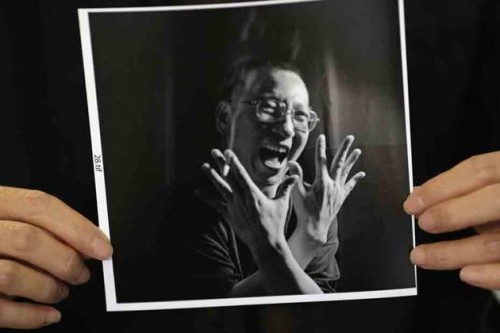
Liu Xiaobo foi preso em 23 de Junho de 2009, acusado de incitar à subversão contra o estado. Foi julgado e condenado em 25 de Dezembro de 2009 a 11 anos de prisão e 2 anos de privação de direitos políticos. Por ter defendido e assinado isto (a tradução para inglês do texto integral pode encontrar-se aqui):
(…)
II. Our Fundamental Concepts
At this historical juncture that will decide the future destiny of China, it is necessary to reflect on the modernization process of the past hundred and some years and reaffirm the following concepts:
Freedom: Freedom is at the core of universal values. The rights of speech, publication, belief, assembly, association, movement, to strike, and to march and demonstrate are all the concrete expressions of freedom. Where freedom does not flourish, there is no modern civilization to speak of.
Human Rights: Human rights are not bestowed by a state; they are inherent rights enjoyed by every person. Guaranteeing human rights is both the most important objective of a government and the foundation of the legitimacy of its public authority; it is also the intrinsic requirement of the policy of “putting people first.” China’s successive political disasters have all been closely related to the disregard for human rights by the ruling establishment. People are the mainstay of a nation; a nation serves its people; government exists for the people.
Equality: The integrity, dignity, and freedom of every individual, regardless of social status, occupation, gender, economic circumstances, ethnicity, skin color, religion, or political belief, are equal. The principles of equality before the law for each and every person and equality in social, economic, cultural, and political rights of all citizens must be implemented.
Republicanism: Republicanism is “joint governing by all, peaceful coexistence,” that is, the separation of powers for checks and balances and the balance of interests; that is, a community comprising many diverse interests, different social groups, and a plurality of cultures and faiths, seeking to peacefully handle public affairs on the basis of equal participation, fair competition, and joint discussion.
Democracy: The most fundamental meaning is that sovereignty resides in the people and the government elected by the people. Democracy has the following basic characteristics:(1) The legitimacy of political power comes from the people; the source of political power is the people. (2) Political control is exercised through choices made by the people. (3) Citizens enjoy the genuine right to vote; officials in key positions at all levels of government must be the product of elections at regular intervals. (4) Respect the decisions of the majority while protecting the basic human rights of the minority. In a word, democracy is the modern public instrument for creating a government “of the people, by the people, and for the people.”
Constitutionalism: Constitutionalism is the principle of guaranteeing basic freedoms and rights of citizens as defined by the constitution through legal provisions and the rule of law, restricting and defining the boundaries of government power and conduct, and providing appropriate institutional capability to carry this out. In China, the era of imperial power is long gone, never to return; in the world at large, the authoritarian system is on the wane; citizens ought to become the true masters of their states. The fundamental way out for China lies only in dispelling the subservient notion of reliance on “enlightened rulers” and “upright officials,” promoting public consciousness of rights as fundamental and participation as a duty, and putting into practice freedom, engaging in democracy, and respecting the law.
III. Our Basic Positions
Thus, in the spirit of responsible and constructive citizens, we put forth the following specific positions regarding various aspects of state administration, citizens’ rights and interests, and social development:
1. Constitutional Amendment: Based on the aforementioned values and concepts, amend the Constitution, deleting clauses in the current Constitution that are not in conformity with the principle that sovereignty resides in the people, so that the Constitution can truly become a document that guarantees human rights and allows for the exercise of public power, and become the enforceable supreme law that no individual, group, or party can violate, establishing the foundation of the legal authority for democratizing China.
2. Separation of Powers and Checks and Balances: Construct a modern government that separates powers and maintains checks and balances among them, that guarantees the separation of legislative, judicial, and executive powers. Establish the principle of statutory administration and responsible government to prevent excessive expansion of executive power; government should be responsible to taxpayers; establish the system of separation of powers and checks and balances between the central and local governments; the central power must be clearly defined and mandated by the Constitution, and
the localities must exercise full autonomy.
3. Legislative Democracy: Legislative bodies at all levels should be created through direct elections; maintain the principle of fairness and justice in making law; and implement legislative democracy.
4. Judicial Independence: The judiciary should transcend partisanship, be free from any interference, exercise judicial independence, and guarantee judicial fairness; it should establish a constitutional court and a system to investigate violations of the Constitution, and uphold the authority of the Constitution. Abolish as soon as possible the Party’s Committees of Political and Legislative Affairs at all levels that seriously endanger the country’s rule of law. Prevent private use of public instruments.
5. Public Use of Public Instruments: Bring the armed forces under state control. Military personnel should render loyalty to the Constitution and to the country. Political party organizations should withdraw from the armed forces; raise the professional standards of the armed forces. All public employees including the police should maintain political neutrality. Abolish discrimination in hiring of public employees based on party affiliation; there should be equality in hiring regardless of party affiliation.
6. Human Rights Guarantees: Guarantee human rights in earnest; protect human dignity. Set up a Commission on Human Rights, responsible to the highest organ of popular will, to prevent government abuse of public authority and violations of human rights, and, especially, to guarantee the personal freedom of citizens. No one shall suffer illegal arrest, detention, subpoena, interrogation, or punishment. Abolish the Reeducation-Through-Labor system.
7. Election of Public Officials: Fully implement the system of democratic elections to realize equal voting rights based on “one person, one vote.” Systematically and gradually implement direct elections of administrative heads at all levels. Regular elections based on free competition and citizen participation in elections for legal public office are inalienable basic human rights.
8. Urban-Rural Equality: Abolish the current urban-rural two-tier household registration system to realize the constitutional right of equality before the law for all citizens and guarantee the citizens’ right to move freely.
9. Freedom of Association: Guarantee citizens’ right to freedom of association. Change the current system of registration upon approval for community groups to a system of record-keeping. Lift the ban on political parties. Regulate party activities according to the Constitution and law; abolish the privilege of one-party monopoly on power; establish the principles of freedom of activities of political parties and fair competition for political parties; normalize and legally regulate party politics.
10. Freedom of Assembly: Freedoms to peacefully assemble, march, demonstrate, and express [opinions] are citizens’ fundamental freedoms stipulated by the Constitution; they should not be subject to illegal interference and unconstitutional restrictions by the ruling party and the government.
11. Freedom of Expression: Realize the freedom of speech, freedom to publish, and academic freedom; guarantee the citizens’ right to know and right to supervise [public institutions]. Enact a “News Law” and a “Publishing Law,” lift the ban on reporting, repeal the “crime of inciting subversion of state power” clause in the current Criminal Law, and put an end to punishing speech as a crime.
12. Freedom of Religion: Guarantee freedom of religion and freedom of belief, and implement separation of religion and state so that activities involving religion and faith are not subjected to government interference. Examine and repeal administrative statutes, administrative rules, and local statutes that restrict or deprive citizens of religious freedom; ban management of religious activities by administrative legislation. Abolish the system that requires that religious groups (and including places of worship) obtain prior approval of their legal status in order to register, and replace it with a system of record-keeping that requires no scrutiny.
13. Civic Education: Abolish political education and political examinations that are heavy on ideology and serve the one-party rule. Popularize civic education based on universal values and civil rights, establish civic consciousness, and advocate civic virtues that serve society.
14. Property Protection: Establish and protect private property rights, and implement a system based on a free and open market economy; guarantee entrepreneurial freedom, and eliminate administrative monopolies; set up a Committee for the Management of State-Owned Property, responsible to the highest organ of popular will; launch reform of property rights in a legal and orderly fashion, and clarify the ownership of property rights and those responsible; launch a new land movement, advance land privatization, and guarantee in earnest the land property rights of citizens, particularly the farmers.
15. Fiscal Reform: Democratize public finances and guarantee taxpayers’ rights. Set up the structure and operational mechanism of a public finance system with clearly defined authority and responsibilities, and establish a rational and effective system of decentralized financial authority among various levels of government; carry out a major reform of the tax system, so as to reduce tax rates, simplify the tax system, and equalize the tax burden. Administrative departments may not increase taxes or create new taxes at will without sanction by society obtained through a public elective process and resolution by organs of popular will. Pass property rights reform to diversify and introduce competition mechanisms into the market; lower the threshold for entry into the financial field and create conditions for the development of privately-owned financial enterprises, and fully energize the financial system.
16. Social Security: Establish a social security system that covers all citizens and provides them with basic security in education, medical care, care for the elderly, and employment.
17. Environmental Protection: Protect the ecological environment, promote sustainable development, and take responsibility for future generations and all humanity; clarify and impose the appropriate responsibilities that state and government officials at all levels must take to this end; promote participation and oversight by civil society groups in environmental protection.
18. Federal Republic: Take part in maintaining regional peace and development with an attitude of equality and fairness, and create an image of a responsible great power. Protect the free systems of Hong Kong and Macau .On the premise of freedom and democracy, seek a reconciliation plan for the mainland and Taiwan through equal negotiations and cooperative interaction. Wisely explore possible paths and institutional blueprints for the common prosperity of all ethnic groups, and establish the Federal Republic of China under the framework of a democractic and constitutional government.
19. Transitional Justice: Restore the reputation of and give state compensation to individuals, as well as their families, who suffered political persecution during past political movements; release all political prisoners and prisoners of conscience; release all people convicted for their beliefs; establish a Commission for Truth Investigation to find the truth of historical events, determine responsibility, and uphold justice; seek social reconciliation on this foundation.
IV. Conclusion
China, as a great nation of the world, one of the five permanent members of the United Nations Security Council, and a member of the Human Rights Council, ought to make its own contribution to peace for humankind and progress in human rights. Regrettably, however, of all the great nations of the world today, China alone still clings to an authoritarian way of life and has, as a result, created an unbroken chain of human rights disasters and social crises, held back the development of the Chinese people, and hindered the progress of human civilization. This situation must change! We cannot put off political democratization reforms any longer. Therefore, in the civic spirit of daring to take action, we are issuing Charter 08. We hope that all Chinese citizens who share this sense of crisis, responsibility, and mission, whether officials or common people and regardless of social background, will put aside our differences to seek common ground and come to take an active part in this citizens’ movement, to promote the great transformation of Chinese society together, so that we can soon establish a free, democratic, and constitutional nation, fulfilling the aspirations and dreams that our countrymen have been pursuing tirelessly for more than a hundred years.
* – na foto, Liu Xiaobo. As mãos que a seguram são as da sua mulher, actualmente em prisão domiciliária
O Rui Rocha delicia-me com a sua escrita. E no final da leitura deste post, dou comigo envergonhada. Como é possível que Portugal esteja de mão-beijada com o crápula regime chinês e seus apêndices. Apêndices? É verdade, ouvi esta manhã na rádio que Ramos Horta, dito presidente de Timor-leste, que recebeu um Prémio Nobel da Paz, acatou de imediato as ordens da China para não comparecer à cerimónia em Oslo. E é com este Ramos Horta que o primeiro-ministro José Sócrates gosta de conviver, leia-se entregar o nosso dinheiro, de tal modo que lá vai no início do próximo ano visitar o amigão a Timor.
Agradeço as suas palavras. Ramo Horta tinha, mais que qualquer outro, a obrigação de honrar o Prémio Nobel. Diz-me com quem andas, dir-te-ei quem és…
Oportuníssimo. Para que ninguém diga que não sabia.
São mais cegos os que não querem ver, Sérgio.
A realidade é que, apesar de ser condenável a prisão por delito de opinião, a luta do homem em nada tem objectivos de Paz, sobretudo porque a China não é nem nunca foi beligerante ao estilo americano ou soviético. Desse ponto de vista, o discurso oficial do PCP foi bastante mais lúcido que a maioria das pessoas que insistem em declarar que este lutador merece o Nobel da Paz: o que Liu merece é ser libertado.
Penso que, sem estar a ser demagogo, o Nobel da Paz cairia melhor num dos senadores americanos que se opuseram à guerra do Iraque: o democrata Dennis Kucinich ou o republicano Ron Paul. Esses ou outros ainda mais activistas que se tenham esforçado por mostrar que as premissas da guerra no Iraque serviram propósitos privados.
Só existe um Prémio Nobel por ano, caro AA. Por cada um que é entregue existem certamente milhares de outros que, de forma mais ou menos anónima, mereceriam também recebê-lo. No fundo, é um prémio à esperança, independentemente de quem o receber.
E já agora, a prisão de Assange, longe de ser realizada por causa de violações ou coisa que o valha, está bastante próxima de ter como causa real o “incitamento à subversão contra o Estado”. Não oficialmente, mas também em Cuba e no Portugal fascista nunca houve presos com estatuto oficial de “dissidentes” ou por “incitarem à subversão contra o Estado”.
O Prémio Nobel atribuído a Liu Xiaobo simboliza precisamente a indignação contra tais práticas onde quer que possam ocorrer.
Para isso que se crie uma categoria do Prémio Nobel dedicado à Liberdade de Expressão. Paz é paz, liberdade de expressão é liberdade de expressão.
Penso ter respondido num post mais acima. É o melhor que sei fazer. Se não consegui, não sei responder-lhe.
Serviço público, Rui.
Gratuito e universal, Pedro (no sentido de que está disponível para quem quiser ler).
Um discurso orientado para a Liberdade não é necessariamente um discurso orientado para a Paz. Prova disso foram as guerras em que os EUA se envolveram nas últimas décadas, que, concorde-se ou não, tinham a temática da Paz como pano de fundo.
Ora, o discurso de Liu não tem nada a ver com a Paz.
Obama estava muito mais envolvido na questão da Paz mundial: merecidca ou não, foi uma decisão certamente menos descabida.
Penso ter respondido num post mais acima. É o melhor que sei fazer. Se não respondi, não sei responder-lhe.
Um discurso sobre a liberdade nada tem a ver com a paz? Essa é nova para mim. Sem liberdade jamais poderá haver paz – a verdadeira paz não é a das prisões nem dos cemitérios.
Se a Paz não é a das prisões nem dos cemitérios, por que razão recebeu Obama o Nobel? (Alô Guantánamo e Iraque e Afeganistão e bases espalhadas pelo mundo inteiro!)
É a novilíngua da democracia liberal do ocidente. Não falha. Fazer a guerra para manter a paz.
Na altura oportuna, critiquei essa escolha do Comité Nobel, que me pareceu totalmente descabida. Essa sim. Também – mas não só – pelos motivos que menciona.
«a excelência de Bush na luta contra o terrorismo [no Iraque] não pode ser negada»
«Para lidar com o terrorismo, como ameaça extrema sobre a civilização humana, os Estados Unidos não devem ter nenhuma hesitação no uso da força. É preciso determinação para impedir que um desastre semelhante ao 11 de Setembro aconteça novamente, para reduzir o crescimento do terrorismo internacional e a ameaça de armas de destruição em massa.»
Liu Xiaobo
http://ocastendo.blogs.sapo.pt/1068544.h
Sublinho um ponto: Liu Xiaobo está preso. Nos EUA não falta quem tenha criticado, ridicularizado ou atacado Bush. Os que o fizeram estão em liberdade. Você tem a liberdade de se manifestar e de citar Liu Xiaobo e eu a de discordar da sua prisão. Esta liberdade faz toda a diferença entre nós e Liu Xiaobo.
A China é de facto um grande país, com uma economia de peso, mas o seu regime político transforma a nação num pequeno tigre de papel que não convive bem com a democracia. Com a atribuição do Nobel da Paz a Liu Xiaobo isso ainda foi mais evidente: a censura rançosa do moderno social-comunismo nos meios audiovisuais, na internet e a tentativa de intimidar os países que marcassem a sua presença em Oslo. O cúmulo do despeito aconteceu com a criação apressada do Prémio Confúcio da Paz que acabou por ser um contra-senso pois a doutrina filosófica do confucionismo baseia-se na consciência política e no respeito pelos valores morais e sociais. Nem a compra de parte da dívida pública portuguesa pela China poderá jamais branquear o desterro do Dalai Lama, o massacre de Tiananmen e as constantes violações dos direitos humanos de personagens como Liu Xiaobo.
Subscrevo, Dylan.